Tuxedo Dance Hall
235 CrozatNew Orleans LA 70112
The Tuxedo Dance Hall was a venue in Storyville, New Orleans’ legendary red light district, which helped launch the Tuxedo Jazz Band, the world’s oldest jazz group performing today. It was the site of a fatal shootout that reconfigured the music scene in
The group now called the Original Tuxedo Jazz Band traces its origins to the bandstand at the hall, where Oscar “Papa” Celestin held forth beginning in 1912. Since then, the band has included some of the finest musicians in New Orleans, from Louis Armstrong to Dave Bartholomew to Trombone Shorty.
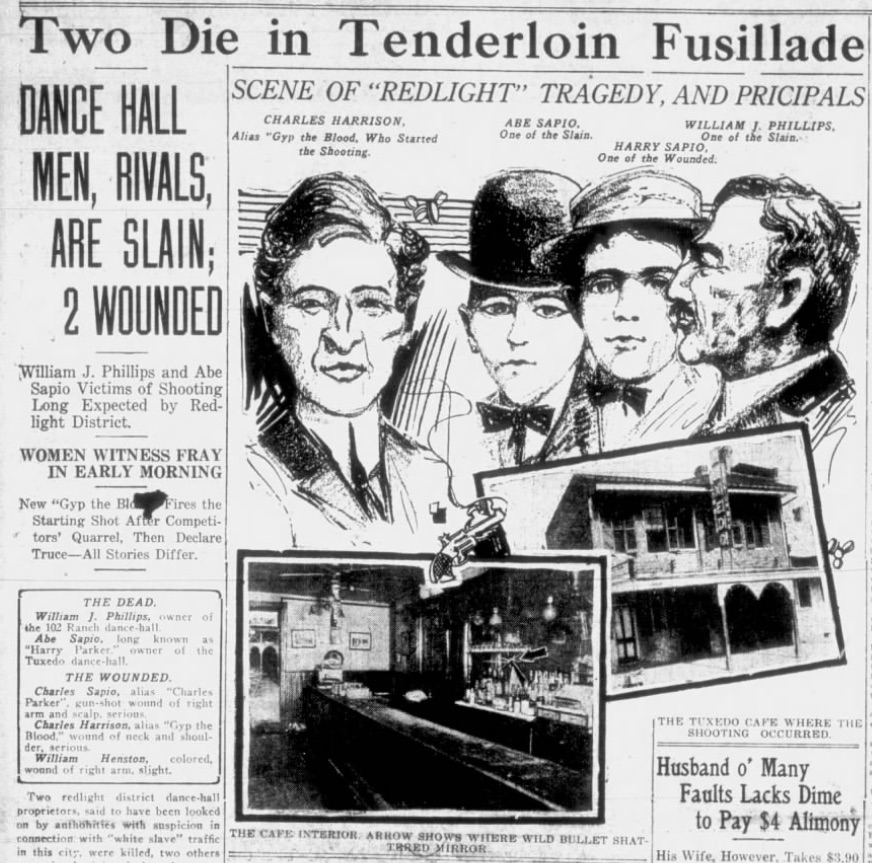
In 1913, the Times-Picayune called the Tuxedo “a model of the dance halls which make up a good part of the tenderloin.” The business was open for less than a year, however, owing to a gunfight in its saloon that killed one of its owners and one of his competitors.
The shooting led to the temporary closure of every music venue in the district, likely contributing to its gradual decline. The incident also fueled a social reform movement that dogged nightlife citywide for years to come.
Several months after the shooting, the venue reopened as the Villa, and presented important early jazz artists for another year or two. However, its scofflaw proprietor struggled to recapture the Tuxedo’s glory under increased scrutiny by the authorities.
From the perspective of public officials, reformers, and the mainstream press of the 1910s, the dance music played at the hall was soiled by the moral degeneracy of its surroundings (and by the race of the people playing it). But, as early as the 1920s, the Tuxedo Jazz Band was in demand by all segments of New Orleans society, including the white elite.
Though the band left the Tuxedo Dance Hall far behind, the history of the venue contextualizes the group’s achievement: Amid the exploitation and volatility of Storyville, and a public campaign to suppress musical performances, a group of Afro Creole and African American musicians created an enduring institution.
Origin of the Tuxedo Dance Hall
In the decades after the Civil War, this stretch of Franklin Street was bustling with dance halls, saloons, gambling dens, and houses of ill fame. The clientele was mostly Black, but, like the residents of the working-class neighborhood around it, included European immigrants and others who worked on the riverfront.
In the late 1800s, music on the block whipped dancers into a “perfect frenzy,” according to a scandalized reporter for the New Orleans Item. When civic leaders voted to create Storyville in 1897, they drew its boundaries around this stretch of Franklin Street, which they already associated with the dregs of society. Business boomed.
Manuel “Fess” Manetta, a multi-instrumentalist and bandleader who became a stalwart of the district, said that the building that eventually housed the Tuxedo was a “sporting house,” or brothel, in the early 1900s.
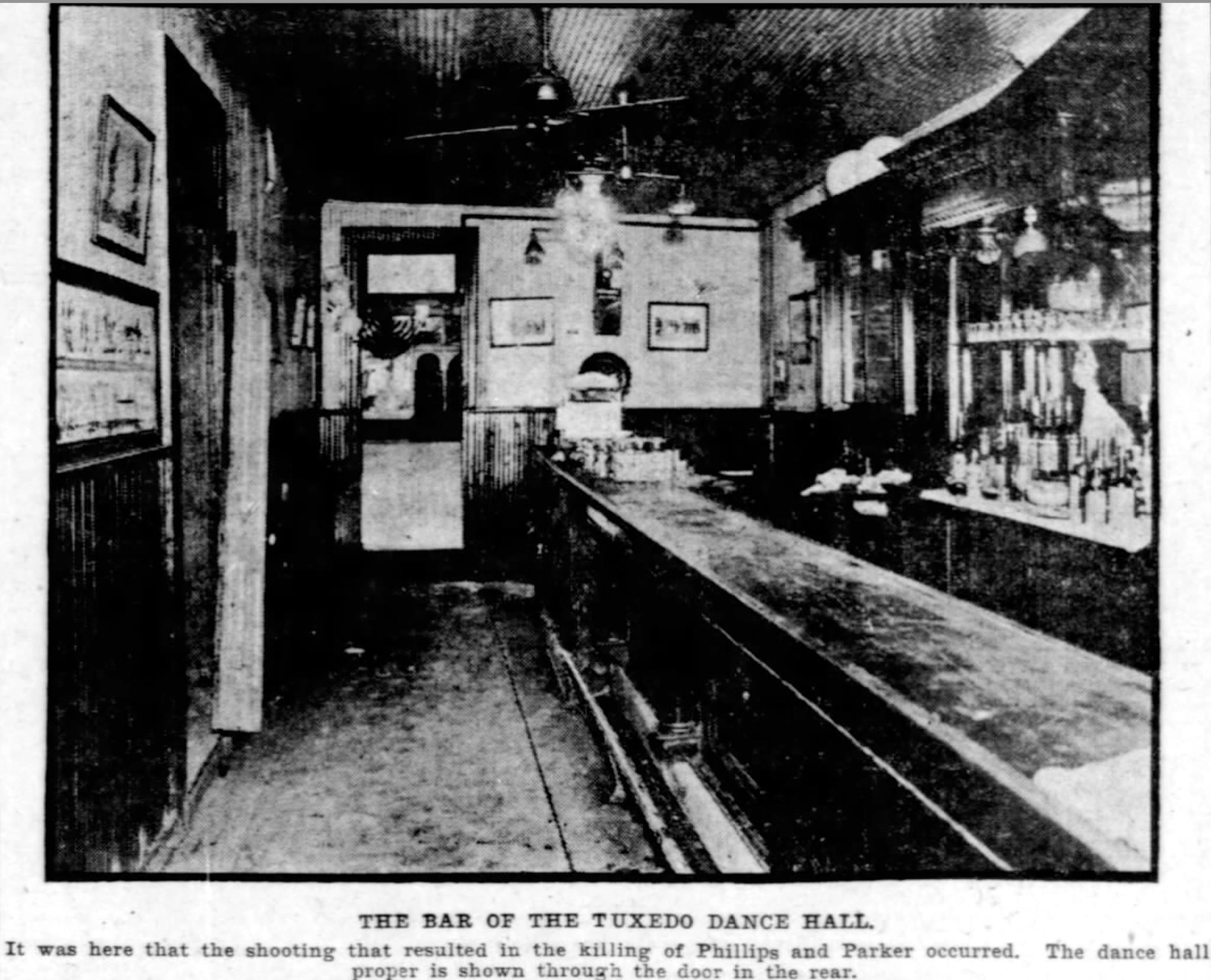
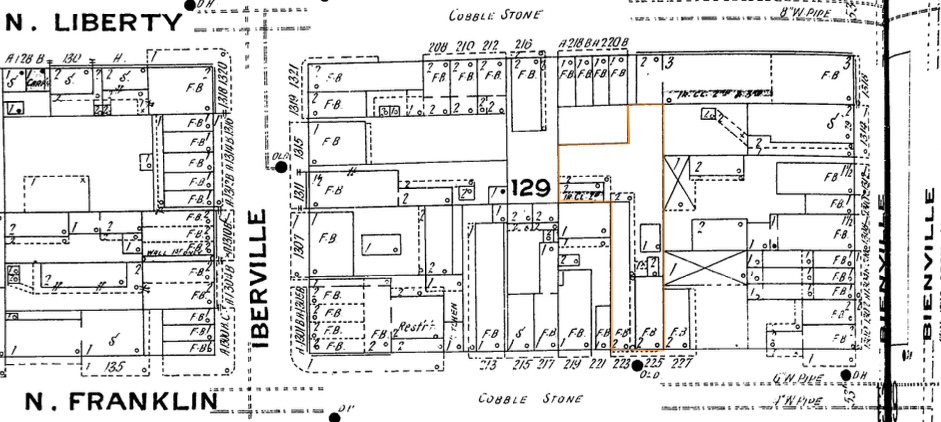
By 1908, the building’s lot was combined with one behind it containing a meeting hall, allowing for its expansion as a saloon, dance hall, and restaurant. The Times-Picayune provided an exceptionally detailed description of the facility:
The bar faces the street and opens, without screens, the full width of the part apportioned to it, onto the street. Petitioned off from the bar is a narrow runway leading to the dance hall. This is a large hall, possibly 100 feet in length and about 30 or 40 feet wide.
At the lower end of the hall a stand has been erected for the music, about 12 feet from the dancing floor, and is connected with a small, narrow stairway. Here a negro band holds forth and from about 8 o’clock at night until 4 o’clock in the morning plays varied rags, conspicuous for being the latest in popular music, interspersed with compositions by the musicians themselves.
Before amplification, the elevated bandstand—essentially an indoor balcony—let musicians project their sound above the crowded dance floor.
Ranged along the walls on each side of the dancing floors are boxes or booths, in each of which is a table with benches for the accommodation of such as desire to watch the dancers while sipping beer, liquor, or wines…and there can always be found women and men in these boxes and booths, even while there are no other attractions.
The first manager of the place was a dubious character named John William Klinger. He’d spent the first 10 years of the Storyville era compiling a criminal record at the Waldorf, a bar and music venue around the corner. About a year into his tenure here, Klinger was convicted of carousing with five underage girls, ages 14 to 17, who left his saloon “staggering” drunk, according to the Times-Picayune. He went to jail, and the authorities shuttered the business.
The building then went up for rent several times before reopening as the Gaiety Dance Hall. Gay times may have ensued, but they didn’t make the papers; the record we have is of its last night in business in 1911, when three men attacked the police officer on duty, who fired his pistol. Authorities shut the place down again.
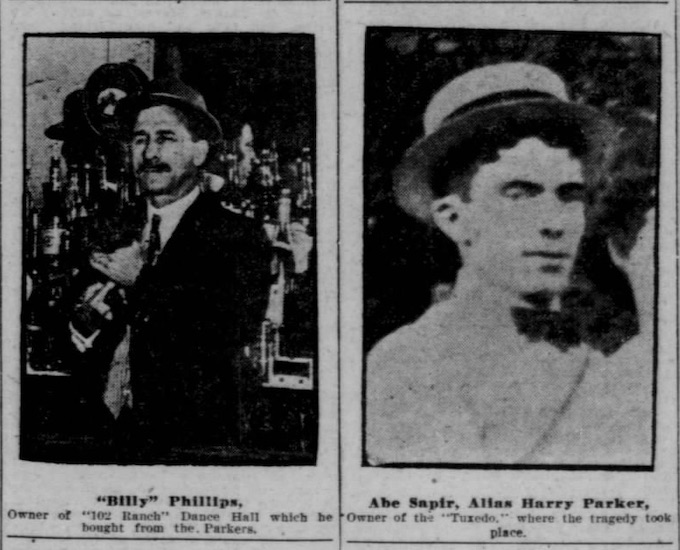
The closure presented an opportunity for two brothers who’d come to the district from the New York underworld under the assumed names Harry and Charles Parker. The Parkers ran the 101 Ranch, a dance hall across Franklin Street, but wanted a bigger piece of the action.
In 1912 they sold their stake in the 101 Ranch to a veteran saloonkeeper named Billy Phillips, and reportedly agreed not to open a competing establishment. However, Harry Parker turned around and renovated the Gaiety as a higher-end dance hall, an aspiration suggested by its new name: the Tuxedo. Parker’s betrayal of Phillips would lead to his death, but not before he hired a house band.
The Inception of the Tuxedo Band
Most accounts of the Tuxedo Band say that the group formed in 1910, but the source of that date appears to be a bandmember’s son’s memory of a note on an old photograph. The likely founding year is 1912, when the city issued a permit for the Tuxedo Dance Hall, which nearly all sources agree provided the band’s name.
Manetta, who played at 101 Ranch, said that Parker sent for him as he remodeled the Gaiety, charging him with assembling “the greatest musicians they have in town” to become the Tuxedo band. (This poaching likely inflamed Billy Phillips; he and Parker reportedly came to blows a few times as the Tuxedo ramped up.)
Manetta tapped Peter Bocage (a forebearer of future R&B great Eddie Bo) on violin, George Fihle on trombone, Arnold Metoyer on trumpet, “Bab” Frank on piccolo, and Louis “Papa” Tio on clarinet, a revered music teacher as well as a performer. Manetta played piano—there was room on the bandstand for an upright, and some potted flowers along the railing.
Each man made a dollar and a quarter a night in base pay, with much more coming when singer and dancer Nooky Johnson passed the hat for tips. The band started at 8 o’clock and played into the wee hours, with a crowd packing the floor under colored electric lights. Sometimes they kept going till the sun was up.
According to Manetta, Metoyer “fell out” of the group because he followed his late nights onstage with long days of playing cotch at Big 25, a hangout for musicians just up Franklin Street. To replace him, the band needed a trumpeter who could read well enough to play the latest songs from sheet music (at this point, the Tuxedo band followed written orchestration).
Conventional wisdom at the time held that Uptown African American musicians lacked the reading skills of Downtown Afro Creole musicians, but Manetta vouched for Oscar Celestin, who lived Uptown and had a day job working on railroad tracks. As Manetta told it, Celestin himself needed some convincing that he had the chops to play with musicians of the Tuxedo’s caliber. But by the second tune of his first gig, “The Flowers That Bloom in the Spring,” he was shining.
Big, tall, and charismatic, Celestin became the face of the group and, according to the Times-Picayune, “the pride of the house” at the Tuxedo. Without naming Celestin, the newspaper noted his “funny facial expressions” and “funny twists of legs,” reporting, with a note of condescension, that “when he led the band people stopped to watch his antics.”
The shootout
The Tuxedo’s success didn’t sink Billy Phillips’ operation, which he dubbed 102 Ranch, but it ratcheted up the tension between him and the Parkers. Phillips, a 36-year-old father of four, wasn’t the sort to roll over after being double crossed.
“Billy was a little man, but he was a brave man,” Manetta remembered. Phillips had earned a reputation at his saloon in the vice district further Uptown, near South Rampart Street, sometimes called Black Storyville. “He would fight and he would shoot,” Manetta said. “Everybody respected him.”
On Easter Sunday in 1913, some of Phillips’ employees went to the Tuxedo around four in the morning. The Times-Picayune reported that Harry Parker grabbed one by the collar, and “commenced beating him and finally forced him outside.” When Phillips heard about this, he went to the Tuxedo himself.
Accounts vary about precisely what happened next, but most agree that Phillips was unarmed, and, after confronting Parker, he tried to order a round of drinks at the Tuxedo—a gesture read variously as an effort to diffuse the situation and a smarmy provocation.
There was no ambiguity about what happened next: an associate of the Parkers called Gyp the Blood put a .38 to Phillips’ back and started shooting. Phillips’ coat caught fire, and he ran into the street, fatally wounded, while a fusillade of bullets tore through the Tuxedo.
“Taking place in a small, crowded room, the battle was a desperate one,” according to the Times-Democrat.
The Tuxedo band was off that night, but in the dance hall behind the barroom music was provided by a pick-up quartet composed of Manetta, Bocage, Tio, and Louis Cottrell, Sr., an influential drummer and, like Tio, an admired teacher of his instrument and patriarch of a musical family.
Author Al Rose and others have denied the legitimacy of these musicians’ accounts of that night, claiming that the official prohibition of live music on Sunday nights meant that they weren’t actually there, and suggesting that they sought to glorify their connection to the famous event after the fact. However, businesses in the district routinely flouted the Sunday law—a single crackdown in 1917 netted 161 indictments. And we have no reason to believe that Harry Parker, a gangster with a long criminal record, was more deferential to the municipal code than his colleagues.
Moreover, the musicians’ memories, recorded separately decades after the fact, aligned on the basics of what happened. “We heard the guns going off,” Manetta said. “They were running through the hall shooting—nothing but smoke … Cottrell was praying, saying his rosary.” The musicians escaped through a back door and scrambled through an alley to Liberty Street.
When the smoke cleared, Phillips and Harry Parker were dead, and Charles Parker and Gyp the Blood were injured. Charles Parker later left town, as did Gyp the Blood, after standing for two mistrials for the murder of Phillips. (No one was arraigned for the murder of Harry Parker.)
Immediately following the shooting, police closed every dance hall in Storyville. The shutdown took the air out of the music scene in the district, but the venues adjusted and began reopening after a few months (some secondary sources say that the closure lasted a year or more, but a review of contemporary records shows that the Tuxedo was up and running by the fall).
Harry Brooks and the Villa Cabaret
With the Parkers out of the picture, their partner Harry C. Brooks assumed control of the business. According to Manetta, Brooks was an underworld “big shot.” In the aftermath of the double homicide, the authorities treated him as such, aggressively pursuing him for offenses large and small.
In May 1913 federal prosecutors arraigned him for violating the Mann “White Slavery” Act by transporting two women to the district from New York for “immoral purposes.” But that case was dropped, as were local ones, and Brooks set about reviving his club over the summer.
To begin, he rebranded it the Villa Cabaret and Café, likely dropping the term “dance hall” because such establishments were in the crosshairs of law enforcement and reformers. As the Times-Picayune depicted it:
In the place of the dance halls which once did such a tremendous business, cabarets have been effectively established, tables and chairs taking up all the available space once used for dancing. Now instead of noisy negro bands the low whining of half tuned string instruments and the strumming of a piano are heard…
Brooks’ turn to the cabaret format didn’t erase the venue’s reputation, however, as Brooks learned when a booking agent sent him the Mortimer Sisters, a vaudeville song-and-dance duo from out of town. After hearing about the Villa they refused to perform, and wound up going to the police. This led to another charge against Brooks for violating the Mann act.
“The theory of the government is that in a dance hall in the restricted district a girl could not…be employed for a moral purpose,” the Times-Democrat reported.
Brooks would be found not guilty, but, while the case played out in federal court, local officials “nailed down the lid on the cabaret shows of the restricted district,” according to the States-Item. If venues wanted to employ women as entertainers, they would have to pay a police officer $2.50 per night to stand guard.
Brooks opted to pay for the detail, and, while the place was still called a “cabaret,” the tables and chairs seem to have been pushed to the periphery, as dance music issued once again from the bandstand.
Manetta said that the venue’s new manager sent for him, so he put together another band, which for a time included a teenaged Warren “Baby” Dodds on drums. Manetta also recalled that Lawrence Duhé led a band at the Villa, and younger musicians turned up to listen, including clarinet prodigy Sidney Bechet, and some white players who’d go on to national fame a few years later in the Original Dixieland Jazz Band.
Several secondary sources say that Celestin also returned to the Villa, and some put him in the band with Manetta and Dodds (parsing the situation is difficult in part because few writers seemed to realize that the Villa and the Tuxedo were the same place).
We know that Celestin and trombonist William “Bébé” Ridgley (the great-uncle of R&B singers Tommy Ridgley and Sammy Ridgley) teamed up across the street at 102 Ranch around 1914. It’s possible that Celestin’s departure for that gig occasioned the Villa’s help wanted ad in September of that year for a “six-piece colored band” for “steady work.”
That Brooks felt compelled to place such an ad, and attempted a second rebrand, as The Tip Café, suggest that the venue struggled to regain its status in the years following the shootout.
As business got harder in Storyville, Brooks might have shifted his focus to another nightspot of his, the Pup Café, which he opened around the same time he reconfigured the Villa in 1913. The Pup was on Iberville Street, just across Rampart—part of the nascent Tango Belt, an entertainment district adjacent to Storyville but not yet subject to the same level of attention by the authorities. The pup became a popular cabaret, but after a few years it, too, became a frequent target of police raids.
In 1917, the city shut down Storyville under pressure from the federal government. The Pup continued to host jazz and vaudeville acts, but in 1918 the city banned live music in cabarets, and in 1919 Brooks was arrested again for permitting women “to congregate for immoral purposes.” The Pup was shuttered and he left town before the trial was scheduled to begin.
Brooks couldn’t outrun the law forever, though. During the Great Depression, he and a partner were convicted of kidnapping a wealthy attorney in California and burning his feet to extract information about the location of some cash. Hours before Brooks was to be hanged for this, the governor commuted his death sentence, giving him life in prison.
Legacies of the Tuxedo Dance Hall
While the press heaped contempt on proprietors of “dives” like Brooks, it praised the industry of Ike Herdman, owner of the Tuxedo building, who took a cut of Brooks’ profits.
A penniless immigrant to New Orleans in the 1880s, Herdman began working as an itinerant glazier, eventually earning enough to buy property in the city. Focusing on commercial real estate, he seized the opportunity Storyville offered to those willing and able to invest in legalized vice. He bought several buildings in the district and rented them to operators like Brooks and the Parkers.
When Herdman died in 1916, he left today’s equivalent of a multi-million-dollar estate to a son in Odessa whom he hadn’t seen in decades, and to grandchildren he’d never met.
As Black men in a time of increasing racial discrimination, Celestin, Ridgley, and their bandmates at 102 Ranch couldn’t follow such a path to prosperity, but they used their business savvy to pivot away from employers like Brooks.
Celestin and Ridgley appropriated the name Tuxedo Jazz Band, and did well for themselves co-leading the group at the 102 Ranch. Their lineup fluctuated, but included original Tuxedo house band member Peter Bocage; clarinetist Lorenzo Tio, nephew of original Tuxedo house band member “Papa” Tio; and Louis Cottrell, Sr., who’d run out the back door of the Tuxedo during the shootout.
After the district was shut down, Ridgley was willing and able to make connections elsewhere, even among the socialites whose dances were covered in the Times-Picayune. The band started performing in tuxedos, outfitting them for formal functions and reinforcing their name for dance floors full of new potential customers.
Celestin and Ridgley also formed a brass band for funerals, parades, and other such events. In 1918, Celestin’s health kept him from a parade gig, and Joe Oliver, another veteran of the 102 Ranch, suggested his young protégé, Louis Armstrong, as a replacement. Ridgely was skeptical when the 16-year-old reported for duty who “had on a police cap that looked as if it were too large for him, a little old blue coat, and a little dirty bag under his arm for his cornet.” But the youngster’s talent won Ridgley over.
“I thought I was in Heaven playing second trumpet in the Tuxedo Brass Band,” Armstrong remembered. By this point, the Tuxedo had a reputation as a high-class outfit.
In a few years, they’d be familiar figures at functions held by the city’s elite. As jazz historian Bruce Raeburn summarized their accomplishments of the period:
The Tuxedo was one of the first jazz bands to record in New Orleans (in January 1925); it was instrumental in the organization of Local 496, the black American Federation of Musicians union in New Orleans (established in July 1926); it was one of the earliest jazz bands to employ women regularly (as pianists); and it built a loyal following that spanned conventional racial and ethnic categories by providing an infectious dance music that was popular among black and white audiences from the bottom of society to the top.
Though business slowed during the Depression, Celestin continued to lead the band, and became a major figure in the midcentury revival of traditional jazz. After his death in 1954, trombonist Eddie Pierson took over the role, followed by banjoist Albert “Papa” French, drummer Bob French, and drummer Gerald “The Giant” French, who leads the band today.
Videos
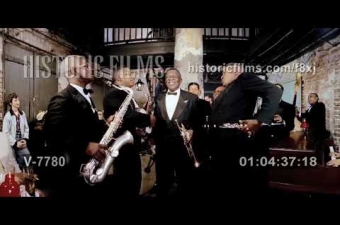
Oscar "Papa" Celestin, leader of the Tuxedo Jazz Band, performing "Tiger Rag" ca. 1954, the last year of his life.
Video posted by Historic Films Stock Footage Archive.
Oscar "Papa" Celestin, leader of the Tuxedo Jazz Band, performing "Tiger Rag" ca. 1954, the last year of his life.
Audio recording of "Give Me Some More" by Celestin's Original Tuxedo Jazz Orchestra with accompanying photo montage.
Video posted by Martin Schuurman.
Audio recording of "Give Me Some More" by Celestin's Original Tuxedo Jazz Orchestra with accompanying photo montage.
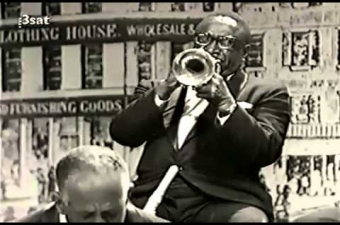
The Original Tuxedo Jazz Band in concert in 1964, under the leadership of Albert "Papa" French.
Video posted by CrescentCityMusic-Norbert Susemihl Jazz Archive.
The Original Tuxedo Jazz Band in concert in 1964, under the leadership of Albert "Papa" French.

Gerald French, current leader of the Original Tuxedo Jazz Band, discusses the group and its legacy.
Video by The Potomac River Jazz Club.
Gerald French, current leader of the Original Tuxedo Jazz Band, discusses the group and its legacy.
Images