Hurricane Katrina
Hurricane Katrina cleaved the history of New Orleans music into two eras: before and after the levees failed on August 29, 2005.
Prior to the storm, the city’s music often came from neighborhood-based networks: extended families and associates who lived, worked, worshipped, and made art together. Those networks, active continuously before the dawn of jazz through the spread of hip hop, fractured when the flood displaced hundreds of thousands of people.
While artists made remarkable efforts to continue their work, structural changes in the city, such as the dismantling of its public housing and school systems, prevented many residents from returning to their neighborhoods. As a result, many of the homes, churches, schools, barrooms, and other places that gave rise to New Orleans music were lost or transformed.
Twenty years later, areas that historically turned out a disproportionate number of musicians, including Central City, Treme, and the Seventh Ward, have been heavily gentrified. The city proper has 120,000 fewer Black residents than before the storm, and many who remain have limited opportunities to keep up with the increased cost of living.
This population loss is not just a result of the emptying of the city after the flood. More recently, a shortage of affordable housing and other issues, such as skyrocketing insurance rates, are driving a long-term sustainability crisis: Between 2020 and 2024, New Orleans was the fastest-shrinking major metropolitan area in America.
Despite everything, though, the city’s music plays on. Two of its foundational traditions, second lines and gatherings of Black Masking Indians (also called Mardi Gras Indians), are thriving. Live music on Frenchmen Street has developed into a national attraction. A few artists who grew up in the pre-Katrina music community, including Big Freedia and Jon Batiste, have since become stars.
The existential threat posed by the flood deepened an appreciation for New Orleans culture among much of the general public. Local musicians and culture bearers, including members of the second line and Indian communities, benefited from an outpouring of private philanthropy and media attention in the wake of Katrina.
In the ensuing years, mainstream institutions offered greater support for practices they had previously taken for granted or disregarded, such as bounce music and dance.
A defining tension of Katrina’s legacy, then, is the simultaneous elevation of New Orleans’ cultural expressions and gutting of the neighborhoods that produced them.
The Roots of Music and Institutional Withdrawal
The music community is adapting to this push and pull, as it has to previous threats and opportunities since the days of Congo Square. The Roots of Music program is a case in point.
Roots founder Derrick Tabb grew up in Treme, surrounded by music: it came from barrooms like Joe’s Cozy Corner, the Charbonnet Funeral Home, courtyards of the Lafitte public housing development, front porches, and street parades. Drumming became a discipline for him at Bell Middle School, and he went on to a Grammy-winning career in the Rebirth Brass Band.
After Katrina, the City shuttered Bell and the Lafitte, and NOPD arrested Tabb for drumming at a memorial event up the block from Charbonnet, where some new residents objected to the community’s longstanding tradition of music in the public square.
Seeing young people cut off from the kind of mentoring and musical education he’d found in the neighborhood before Katrina, Tabb created the Roots of Music, an after-school marching band program for low-income students from across the city. The program has been an award-winning success, changing the lives of thousands of young people since 2007.
A look at Roots’ structure reveals the breadth of the institutional withdrawal that Tabb ventured to counteract.
The city’s move from a conventional public school system to a charter-based system resulted in cuts to in-school music programs, so Roots developed an after-school model to help fill the gaps (it also hired band directors who’d lost their jobs). Reductions to public transit contributed to the need for Roots to offer private bus service for its students. The program also provides help with homework and a hot meal—the kind of support that came from elders in places like Treme before post-Katrina housing policies forced them to relocate.
As heroic as Tabb and his team have been, efforts like theirs cannot reach everyone left behind by these systemic convulsions.
To take one measure, in 2018 83% of New Orleans public schools did not have the instruments they needed for music programs.
The sort of music education that Tabb once received on the streets of Treme is even harder to replace. The neighborhood has lost a third of its population since the flood, and gone from from 92% Black to 57% Black. Music isn’t the kind of daily public presence there that it had been for previous generations.
It may take another 20 years to assess the effects of these changes (at which point we may need a more expansive definition of “New Orleans” music, as culture bearers seek affordable housing beyond the city limits). But we can explain how we got to this point.
The Flood
Hurricane Katrina caused widespread failures of New Orleans’ levee system, which was built and maintained by the federal government. The resulting flood covered 80% of the city, wreaking far more destruction than the storm’s wind and rain. Today, Katrina remains the most expensive hurricane in American history, and the second-deadliest.
As the storm approached, some musicians were on summer tours and unable to batten down their homes. Others, financially strapped at the end of a slow month in town, couldn’t afford to evacuate.
When the water rose, at least two musicians, Barry Cowsill and Glenn Rambo, drowned; many others suffered physical and mental trauma in the ensuing chaos, losing loved ones as well as their homes and possessions.
First responders saved the lives of some artists, including Fats Domino, who was feared dead after someone erroneously spray-painted “R.I.P Fats” on his house in the Lower Ninth Ward. The delayed and inadequate emergency response compelled other artists to become first responders themselves: Vocalist Charmaine Neville, for one, commandeered a bus to drive stranded people to safety.
Because segregation had consigned many Black New Orleanians to flood-prone parts of town, as a group they sustained the heaviest losses. And since most of the city’s musicians and culture bearers are Black, the flood was particularly devastating to its music community.
The water damaged or destroyed the infrastructure of music-making: artists’ homes, rehearsal spaces, recording studios, record stores, nightclubs, auditoriums, places of worship, schools, instruments, and equipment.
The flood also took irreplaceable artifacts, which were often kept in individuals’ homes. Clarinetist and scholar Dr. Michael White, for example, lost a priceless collection of sheet music, archival photos, and other traditional jazz memorabilia. Others lost family photo albums and one-of-a-kind creations like suits sewn by Black Masking Indians.
When the toxic water was finally pumped out of the city, 93% of the music community was displaced across the country, and their neighborhoods would be uninhabitable for months, years, or, as far as anyone knew at the time, forever.
Artists Advocate for the City’s Recovery
In the fall of 2005, as some elected officials and pundits questioned whether New Orleans should be rebuilt at all, many of the city’s culture bearers found themselves pressed into service as advocates for its recovery.
The Preservation Hall Jazz Band, most of whose members lost their homes in the flood, played on borrowed or donated instruments to raise money for a musicians’ relief fund affiliated with the venue. Other artists in similar straits recorded tracks for benefit albums and performed at fundraising events across the country.
Some even put together their own recovery programs.
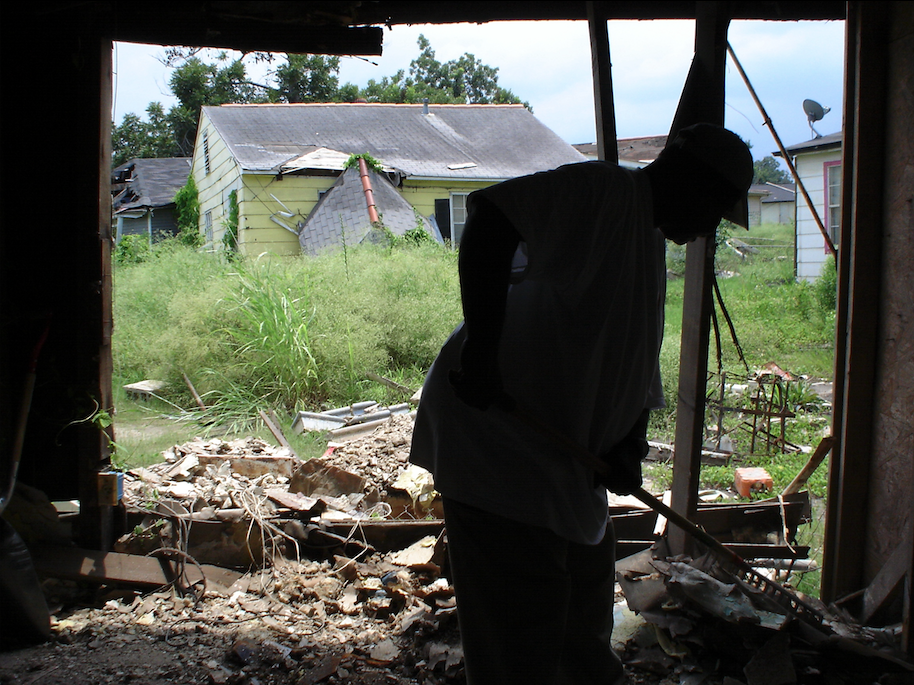
After trombonist Craig Klein gutted his flooded house in Arabi, he and other musicians formed the Arabi Wrecking Krewe, a volunteer house-gutting service for artists who were unable to do the grueling job themselves. The Wrecking Krewe’s work helped signal the desire of displaced families to return to their pre-flood neighborhoods.
Whether or not those families would be allowed to come home remained an open question several months after the storm. In January 2006, most the city’s social aid and pleasure clubs banded together for an enormous second line to support residents’ right to return. Ultimately, the City did not outright prohibit individuals from rebuilding private property.
However, the housing authority sealed off the city’s largest public apartment complexes, regardless of how much damage they sustained. Over vehement protests—including a song by rapper Sess 4-5—thousands of units were ultimately demolished, limiting the supply of affordable housing as low-income families struggled to find a foothold in the city.
The most prominent effort to rehouse musicians was the Musicians Village, a project of New Orleans Area Habitat for Humanity promoted by Harry Connick, Jr. and Branford Marsalis. Habitat struggled to find qualified applicants—many musicians in need of housing lacked the finances and the documentation required to become first-time homeowners—but eventually filled about 80 new houses in the Upper Ninth Ward.
Other philanthropies, like the Higher Ground fund established by Jazz at Lincoln Center under Wynton Marsalis, raised and distributed millions of dollars for direct cash grants and payments for living expenses.
These efforts and others helped musicians return to the New Orleans metro area faster than the general population. Reconstituting their pre-Katrina networks, though, would be an uphill battle.
Prolonged Displacement
Displacement was especially taxing for elders and people with health issues—many evacuees had to travel to multiple temporary shelters, and stay in overcrowded or otherwise inadequate housing. Some, like the renowned Clarence “Gatemouth” Brown and saxophonist Frederick “Shep” Sheppard, died before they could return home.
Other artists found opportunities in new cities. University of New Orleans student Frank Ocean relocated to Los Angeles, where he’d go on to national acclaim. Vocalist Tricia “Sista Teedy” Boutte took an offer of a new home in Norway.
The vast majority wanted to move back to New Orleans, but the slow pace of the city’s recovery compelled some—particularly those with school-aged children—to spend years elsewhere. Others made do with short-term lodging around town, in FEMA trailers or crammed into a relative’s place.
Before the storm, roughly two-thirds of the music community were renters, which made them practically ineligible for government housing assistance in the city: By far the largest public relief program, called the Road Home, spent $9 billion exclusively for homeowners to fix or sell their houses.
Even those qualifying for the Road Home had a litany of complaints about the program. One of them would eventually be echoed by a federal judge, who found that it discriminated against Black homeowners by basing its payments not on the cost of repairs but on the pre-Katrina value of a property.
As the cost of rent in New Orleans soared, culture bearers’ income plummeted. Pre-Katrina, most scraped by thanks to the comparatively low cost of living—Sweet Home New Orleans reported their median pre-Katrina income was $23,312. With paying audiences scarce after the flood, musicians had half as many gigs, and their median income was down to $14,700 five years later.
By 2010, four out of five culture bearers had made their way back to metro New Orleans, but with affordable rentals scarce in their old neighborhoods, more than half wound up in a new part of town. Considering the multigenerational ties many had to their pre-Katrina community, this represented a major change to New Orleans’ cultural ecosystem.
Musicians Help Spur a Revival, But Many Remain at Risk
As the city stabilized and improved economically in the 2010s, narratives of its “resilience” emphasizing its music and culture reached national audiences.
Premiering in 2010, the HBO series “Treme” dramatized the post-Katrina recovery of New Orleans’ music scene, and served as a showcase for local artists including John Boutte, who performed its title song, and others who portrayed themselves on-screen.
One of those artists, Jon Batiste, went on to become the bandleader for Stephen Colbert’s network late-night show in 2015, bringing a new generation of New Orleans-inflected music to millions.
The following year, Big Freedia, in the middle of her reality show’s six-season run, appeared on Beyonce’s hit single “Formation.” The song’s video opens with an image of a flooded New Orleans, and uses footage of second lines, a Black Masking Indian, and drum majors to celebrate the power of Afro Creole culture.
In 2016, tourism in New Orleans surpassed its pre-Katrina peak for the first time. This growth was manifest in new music venues on Frenchmen Street, which, by the end of the decade, supported roughly 1,000 gigs per month.
Yet even while money flowed into the city, and its distinctive Black culture gained a higher profile, structural pressures on culture bearers continued to build.
The City did little to regulate the spread of short-term rentals like Airbnb, which accelerated the gentrification of historic neighborhoods.
Real estate values spiked, making rent more expensive and property taxes less affordable for homeowners with modest incomes. At the same time, wages for musicians remained flat after rebounding only to their pre-Katrina range.
So, while New Orleans’ music scene made considerable gains from the years immediately after the flood, the threat of displacement persisted for its rank and file members.
In 2016, for example, trumpeter John “Kid” Simmons and his wife, civil rights activist Doratha “Dodie” Smith-Simmons, lost their home in the American Can Apartments when the building’s owner took advantage of rising rents by converting units previously set aside for low-income tenants to market-rate units (the couple went through the same ordeal again at the Pythian building in 2022).
As live music expanded down St. Claude Avenue in the Bywater, ballooning housing costs helped turn the neighborhood’s pre-Katrina Black majority (61%) to a minority (20%). Despite this, its second line culture became more visible to passersby in 2016 thanks to a 150-foot-long mural on St. Claude depicting area social aid and pleasure clubs. Among the recognizable faces in the painting was beloved bounce pioneer Cheeky Blakk, who later moved away from New Orleans, leaving her image behind.
Music as Resistance
The economic rebound of the 2010s hit the skids in 2020, when the COVID pandemic shut down the city’s all-important tourism industry.
The virus claimed the lives of elders including Ellis Marsalis and Ronald Lewis, and lockdown was economically disastrous for local musicians, who made far more money from live performances than recorded music.
Then, with a new variant of the virus circulating in 2021–sixteen years to the day after Katrina–Hurricane Ida hit New Orleans. (The new levees held, though high winds brought down the Karnofsky building, a touchstone in Louis Armstrong’s childhood, and damaged Perseverance Hall, a precious early jazz venue, which collapsed in a subsequent thunderstorm.)
Ida was one of several hurricanes to make landfall in Louisiana in this period, driving a statewide insurance crisis—New Orleans-area homeowners saw their premiums jump an average of 200% – 300% between 2020 and 2023 (many landlords passed the expense on to renters).
Combined with rising utility costs, this priced more residents out of the city, even as the tourism industry began to recover from the pandemic.
Through all of these tribulations, the second line calendar has been full to bursting, with new clubs forming and crowds parading down the same streets they have for over a century. And Super Sundays—opportunities for the public to see Black Masking Indians—have grown into major events.
These traditions don’t depend on the ups-and-downs of tourist traffic, or the music industry; they reflect the community’s self-reliance. Rooted in Black resistance to oppression, these practices are more relevant than ever in part because of post-Katrina displacement.
For Sue Press, president of the Ole & Nu Style Fellas Social Aid & Pleasure Club, keeping her house in Treme and continuing to parade through the area every year is even more important in light of her relatives and fellow club members being pushed out.
“People that’s left in this neighborhood, we’re going to hold on together—with every breath in our body—hold on to the memories of our ancestors,” she said.
For those who’ve been displaced, second lines now function as reunions, and a way to stay connected to a place and a ritual that links generations. The same can be said for processions of Black Masking Indians, which have also stuck to their traditional routes.
Back in 2010, a survey found that, compared to their pre-Katrina numbers, 26% more young people were masking Indian, and 11% more young people were parading with social aid and pleasure clubs. In 2025, both traditions continue to attract new participants, and second lines are rolling with a new generation of brass bands.
Recording and touring artists are also playing with a new sense of purpose since the flood. For example, PJ Morton and Trombone Shorty, two sons of musical families who could have parlayed industry success into careers elsewhere, chose to continue their legacies in New Orleans.
Trombone Shorty, who grew up in the same Treme community as Roots of Music founder Derrick Tabb, started an after-school music education program of his own, modeled on Danny Barker’s Fairview Baptist Church youth brass band.
In the 1970s, Barker’s project initiated a brass band renaissance that has been one of the most important cultural movements in New Orleans over the last 50 years. It centered on a church a couple of blocks from his Seventh Ward home, and its earliest recruits included Leroy Jones, who lived around the corner, and Gregory Davis, who stayed across the street in the St. Bernard public housing development.
After being damaged in the flood, the church, Barker’s house, Jones’ house, and the St. Bernard have all been demolished, and much of the area’s pre-Katrina community has been dispersed.
Twenty years later, the work before Tabb, Trombone Shorty, and others, is to cultivate new communities, not within neighborhoods but across them, based on a shared commitment to the practices they once fostered.
Videos
Al "Carnival Time" Johnson wrote "Lower Ninth Ward Blues" to memorialize the loss of his longtime home in the neighborhood.
Video posted by Al "Carnival Time" Johnson.
Al "Carnival Time" Johnson wrote "Lower Ninth Ward Blues" to memorialize the loss of his longtime home in the neighborhood.
"We Made it Through That Water" by the Free Agents Brass Band reflected displaced residents' drive to return to New Orleans.
Video posted by Free Agents Brass Band.
"We Made it Through That Water" by the Free Agents Brass Band reflected displaced residents' drive to return to New Orleans.
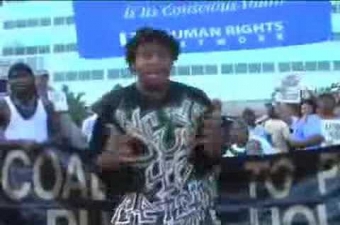
"No Surrender No Retreat" by Sess 4-5 channeled opposition to the demolition of public housing after the flood.
Video posted by theDreamAkeem.
"No Surrender No Retreat" by Sess 4-5 channeled opposition to the demolition of public housing after the flood.
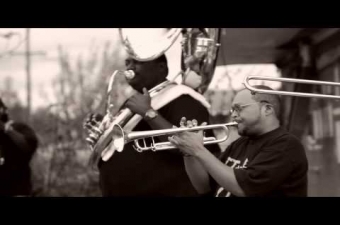
"Ghost Town" by the Hot 8 Brass Band spoke to the post-Katrina loss of neighborhood-based culture.
Video posted by Tru Thoughts Records.
"Ghost Town" by the Hot 8 Brass Band spoke to the post-Katrina loss of neighborhood-based culture.
Images