Joe Victor’s Saloon
1534 St. LouisNew Orleans LA 70112
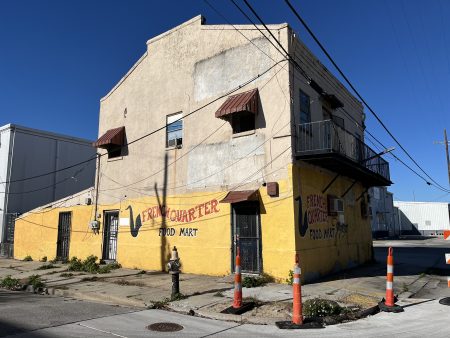
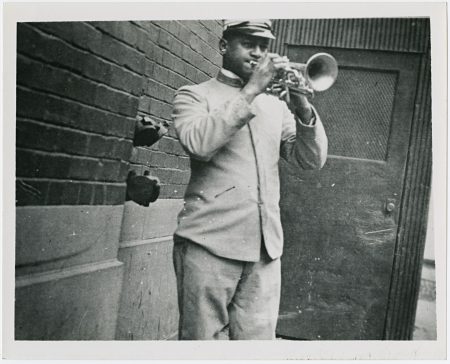
Joe Victor’s Saloon is one of only three extant structures from Storyville, New Orleans’ fabled red-light district, which was integral to the development of jazz in the early 1900s. The business was likely patronized by Freddie Keppard, Buddy Bolden’s successor as the cornet “King” of New Orleans, who grew up two doors down. As a corner store later in the 20th century, it served the Iberville public housing development, home to rappers including Warren Mayes and Rob49.
The saloon operated from 1903 until sometime between 1918 and 1920. Since St. Louis Cemetery No. 2 is just a block away, funeral processions with brass bands probably passed this corner, and may have used the barroom as an assembly and disband point. There also may have been a piano inside (proprietor Joseph Victor was the son of a music teacher), but we have yet to find a record of musical performances here.
Though its musical past is obscure, the building’s broader story sheds light on the often-overlooked community of Afro Creoles, African Americans, and European immigrants who lived side-by-side in this neighborhood and helped shape the life of Storyville.
This diversity may have been embodied by Victor himself, who was listed as “white” in the census, but whose father had been listed previously as “mulatto.” We know that his saloon catered to Black people for at least part of its run, and perhaps throughout it. This makes the building a rarity among rarities: the only remaining Storyville building that connects us to the people of color on the district’s backstreets, beyond the glow of its opulent bordellos.
Origins as a shoe store and residence
For at least the last three decades of the 19th century, the stucco-over-brick building at the corner of St. Louis and N. Villere was home to the Boesel family.
Patriarch John Boesel fled the 1848 revolution in the German Confederation as a child, and made a new life in New Orleans. By 1871 he was running a shoe store on the building’s first floor and living upstairs with his wife and kids.
In 1874, a fire originating in a nearby cooper shop partially destroyed the place, but Boesel rebuilt it. More traumatically, in 1883 his son Frederick died suddenly on the second floor.
We don’t know how these trials affected him, but before dawn on July 6, 1889, Boesel got out of bed, walked downstairs his shop, and took his Smith & Wesson revolver off of the wall, where it hung by a string. He’d fired warning shots from it during a break-in five years earlier, but this time the store and the street were quiet. He took the gun to the outhouse in the back yard, put the barrel to his left ear, and pulled the trigger.
Boesel had “appeared to be pleasant and jovial, and showed no signs of depression” just days before, according to the Times-Picayune. He seemed to be in fine shape financially, too, owning not only the corner building but also a few other properties in the neighborhood.
Whatever its cause, John Boesel’s death helped set the stage for the building’s conversion to a barroom by his son-in-law, William Thomas Barcelo.
Storyville incentivizes conversion to a saloon
John Boesel’s oldest daughter, Antoinette, married Barcelo, himself a child of immigrants, who used the building at St. Louis and Villere as a stepping stone to the upper echelons of New Orleans society.
Barcelo’s father captained ships sailing between New Orleans and his native Spain. After having several children with Barcelo’s mother, who hailed from Ireland, the Captain vanished at sea. This loss seems to have plunged the family into poverty, as the 1880 census found an 18-year-old Barcelo working as a farm hand in rural Point Coupee Parish.
By his twenties, Barcelo had settled in New Orleans, where he embraced civic life. On Mardi Gras Day in 1887, he served as a lieutenant in the Crescent City Flambeau Club, parading down Canal Street behind a brass band and drum corps. Apparently at ease around open flames, by 1892 he was president of the city’s volunteer fireman’s association.
At the time, Barcelo worked as a grocer, renting an apartment across from the Poydras Street Market, where he lived with Antoinette, their children, and his mother. He was a striver, taking leadership positions in the Poydras Market Business Men’s League, and in the Knights of Pythias, a fraternal order. His life took a tragic turn, though, when Antoinette died at age 30 in 1896. Less than a year later, a daughter named for her died at 19 months old.
Meanwhile, in 1897 the city of New Orleans passed the ordinance establishing Storyville, drawing its lower boundary down St. Louis Street. The Boesel family building on the upriver side of the street wound up on the rear edge of the district, dramatically increasing its commercial potential. For the time being, though, it was still home to Antoinette’s mother, two brothers, and younger sister, Barbara.
The next year, Barcelo married Barbara, staying in the Boesel family. When Barbara’s mother died in 1900, the Storyville ordinance was transforming the blocks around the family’s old shoe store. Owners of several of the surrounding Creole cottages subdivided them into “cribs,” rooms big enough for a bed and maybe a wash basin, where sex workers plied their trade at rates below those at the bordellos on Basin Street. Barbara’s brothers moved out, and sold her the property for a pittance.
With the district booming in 1903, the building brought Barcelo and Barbara to Civil District Court. They filed for a partition, a legal process to divide jointly owned property into individual interests. (If the legal action represented an intramarital conflict, it didn’t prevent the couple from staying together for the rest of their lives.) Shortly after the partition, Barcelo got a permit to open a barroom on the building’s first floor.
Jazz pioneers and Barcelo’s rise
While Black musicians including legends like Buddy Bolden and Jelly Roll Morton performed at the district’s upscale establishments around Basin and Iberville streets, they were welcome inside only as employees. If they wanted a drink after getting off the bandstand, they had to go elsewhere, including, plausibly, Barcelo’s place at the back end of the district.
Barcelo could have known some of these jazz pioneers from his years as a grocer: The Poydras Street Market was only steps away from musicians’ haunts like the Little Gem Saloon and the Odd Fellows and Masonic Hall that used to adjoin the Eagle Saloon building on the 400 block of South Rampart Street.
He almost certainly knew the Keppard family, Creoles of color who lived two doors down from the saloon. Their teenage boys, Louis and Freddie, were aspiring musicians whose practice sessions would have been audible to Barcelo. Both would soon play professionally in the district, with Freddie becoming a renowned figure in the history of jazz.
After Bolden was institutionalized in 1907, Keppard became his successor as the “King” of horn men in New Orleans. Jelly Roll Morton was one of many peers to heap praise on Keppard. In Hear Me Talkin’ To Ya, authors Nat Shapiro and Nat Hentoff quote Morton: “I never heard a man that could beat Keppard—his reach was exceptional, both high and low, with all degrees of power, great imagination, and more tone than anybody.” The same book quotes trumpeter Mutt Carey saying of Keppard, “When he hit a note you knew it was hit.”
After several profitable years, Barcelo earned enough to buy a home outside the district, and left the demimonde to run a bar on Canal Street. (That bar later became the Brass Rail, where resident bandleader Paul Gayten helped launch the careers of rock ‘n’ roll heroes Bobby Charles and Clarence “Frogman” Henry.) The New Orleans Item reported that Barcelo also became a partner in Bertrand’s, a well-known saloon at the corner of Canal and Dauphine, a block from the elite Boston Club, at the center of power in the city.
After Prohibition derailed the bar business, Barcelo pivoted onto the board of the Acme Homestead Association and did even better for himself in real estate. In 1927 the New Orleans Item counted him among the “prominent New Orleans business men” who toured the Mississippi River levee that was dynamited to reduce the city’s flood risk, inundating rural communities like the one where Barcelo worked as a teenage farm hand.
Barcelo appears to have maintained his ownership stake in the building at St. Louis and N. Villere for the duration of Storyville’s existence. He probably leased the space to a short, brown-eyed man named Joseph Victor toward the end of 1908, when an ad in the Daily Picayune solicited a renter for a saloon that was “doing good business” in the district.
The ad came just weeks before a new state law, the Gay-Shattuck Act, mandated the segregation of barrooms. That legislators felt such a law was necessary, author Alecia P. Long told A Closer Walk, suggests the prevalence of racially mixed crowds in establishments like Barcelo’s saloon. The law had a loophole, however, for establishments that also served food. Victor, an experienced grocery cook, was well-positioned to exploit it.
Of the two men, Barcelo would have seemed more likely to persevere in the annals of New Orleans history, but, thanks to the unlikely survival of the building at St. Louis and Villere, the name in books today is Victor’s. He ran the saloon for roughly a decade—one of several food and drink service jobs he worked in a seemingly quiet life.
The Victor family
While archival records of Joseph Victor are scant, his father Adolphe’s story offers some intriguing context about the family. Born around 1841, Adolphe Victor was listed as “mulatto” in the 1850 census, as were his parents and four siblings. In 1860 and afterward, the family was listed as “white,” raising the possibility that the Victors chose to conceal their African ancestry as racial oppression worsened in the years leading up to the Civil War.
We know for sure that Adolphe took up the cause of racial equality when the war ended. In 1866, at the Mechanics Institute just off Canal Street, white supremacists killed dozens of delegates to a state constitutional convention advocating Black enfranchisement. The national backlash to the massacre garnered support for a Reconstruction government supporting Black civil rights, which Adolphe joined as a tax assessor. In 1872, he served as a delegate at the Mechanics Institute himself, representing the heavily Afro Creole Seventh Ward in the Republican Parish Convention. (He served as a delegate again in 1876, the year his son Joseph was born.)
In 1880, after the collapse of Reconstruction, Adolphe was out of a job, but his wife Marie worked as a housekeeper. The family moved around, mostly in the Seventh Ward, but also to a place on N. Roman, six blocks from Joseph’s future saloon. By 1900 Adolphe was teaching music, and Joseph was cooking food at a grocery.
By the 1910 census Joseph was behind the bar in the district and living upstairs with two of his sisters, Eugenie and Marie. At that point, he was 33, Eugenie was 28, and Marie was 26. Joseph would live with some combination of his sisters for the rest of his life, and neither he, nor Eugenie, nor Marie ever married, or had children recorded with them on a census.
Could the family’s African ancestry have come to light, marginalizing them in “white” society? Could Eugenie and Marie have been sex workers, like so many other women in the district? So far, we have no documentary evidence to say.
Joe Victor’s Saloon
In 1911, Joseph was listed in the City Directory as a “grocer,” indicating that his saloon offered basic provisions as well as alcoholic drinks. Beyond working around the Gay-Shattuck Act, this suggests that the business catered more to nearby residents than to the well-heeled white men visiting the Basin Street bordellos for a night.
In the book Storyville, New Orleans, author Al Rose wrote that in 1914 the blocks on the district’s side of St. Louis Street were “lined with cribs…almost exclusively used by Negro women and patronized by Negro men, though groups of white boys, usually teen-agers, could often be found taking advantage of the lower prices prevailing out of the high-rent area.” These workers and patrons were likely Joseph’s customers as well.
By 1915, the District started to decline, and ads to rent a “grocery and bar and 7 rooms” at St. Louis and Villere appeared in the newspaper. Joseph and his sisters appear to have extended their lease, though.
In January 1917, Joseph renewed the permit to operate a “colored bar room” in the building, “the said bar room having been heretofore duly and legally operated as such,” the States wrote, affirming that Joe Victor’s saloon was a Black bar.
Joseph sustained his business for at least a little while beyond the official closure of Storyville in 1917. He apparently accomplished this through an arrangement with a German immigrant named Adolph Flasdick, who tended bar in a saloon down the block. Flasdick, whom Joseph listed as his employer in 1918, appears to have been a natural leader for a saloon. He went on to be a custodian of Deutsches Haus, the venue for New Orleans’ Oktoberfest, and to appear in a Jax Beer ad hoisting a frosty pint—not his first of the day, judging from his grin and tousled hair.
Not even Flasdick could save the business from Prohibition, however. By the 1920 census Joseph and his sisters had moved uptown, where he worked in another grocery store. In 1923, the building at St. Louis and Villere operated as a grocery and “soft-drink stand.”
Various tenants resided on the second floor in this period, when, according to Alecia P. Long, Black residents who’d been priced out as a result of the Storyville ordinance returned to the neighborhood. Not coincidentally, city leaders in the 1930s came to regard the area as a “slum,” which they were eager to do away with.
Public housing replaces Storyville, the saloon becomes a grocery
City leaders used the New Deal’s public housing program to wipe Storyville off the map and, as historian Arnold R. Hirsch noted, impose a previously unattainable level of segregation on the neighborhood. The entire district was bulldozed except for the block that Joseph’s saloon had been on, and a half-block of Basin Street (the site of the district’s two other surviving structures). The land was redeveloped as a low-rise, garden apartment complex for white tenants only.
The Iberville opened in 1941 with 858 apartments, ensuring the viability of a corner store at St. Louis and Villere. Around 1950 Thomas and Josephine Caffery took it over, naming it T&J Grocery and moving into the apartment upstairs.
Their son Tom was about seven years old at the time: “I remember the beautiful bar” on the first floor, he told A Closer Walk. “Mahogany, mirrors behind it—it was really pretty. My mom was in a real hurry to get rid of that because of the story behind it.” The Cafferys were devout Catholics, and wanted no part of Storyville’s sinful reputation.
Their purge continued upstairs, where, according to neighborhood lore, several cribs had operated in the Storyville days. We have yet to find a paper trail of sex work at the address, but Caffery found that the story could explain otherwise baffling features of second floor layout: a door to nowhere at the top of the stairs, and a wooden walkway along one wall that could have provided access to a row of private rooms.
Tom’s memory isn’t conclusive, but raises questions about how prostitution might have fit into Barcelo and Victor’s businesses. Could this have been how Barcelo made enough money to buy a new house after five years in the district? Could the cribs have been installed as part of the arrangement between Joseph and Flasdick, his employer late in the saloon’s run?
In any case, Tom’s parents found tales of sex work in their new home credible enough to tear out the wooden walkway and renovate the second floor (they also eventually put an addition on the first floor, which served as their den). The family lived in the building for much of the 1950s and 60s, selling groceries to residents of Iberville across the street. Tom helped stock the shelves, and delivered groceries to folks in the project.
Tom remembers the Iberville as “immaculate” in the early years, when regular inspections of its units compelled tenants to maintain them. He recalls the residents as a mix of some “rough” characters along with a few sophisticated French-speaking women, and a teenage girl whom his father teased for being shy when she came into the grocery. “You’ll never get a date like that,” he said, not knowing that his son would later marry her.
T&J was a neighborhood fixture, not only for residents of the Iberville but for workers at nearby industrial facilities who came in for lunch. The store got regular deliveries of Leidenheimer bread, and served up sausage po-boys as well as cheaper luncheon meat sandwiches.
By the late 1960s, T&J had been robbed a few times. After a perpetrator threatened to shoot Josephine, the family left the building behind. Tom continued to drive by it once in a while, recalling the good times of his childhood there.
Videos

Panel discussion on Storyville from the New Orleans Jazz Museum in November 2025 with Sally Asher, John McCusker, Eric Seiferth, and Claus Sadlier.
Video by NOLA Jazz Museum.
Panel discussion on Storyville from the New Orleans Jazz Museum in November 2025 with Sally Asher, John McCusker, Eric Seiferth, and Claus Sadlier.
Images