Lower Ninth Ward Blues: Hurricane Katrina Tour
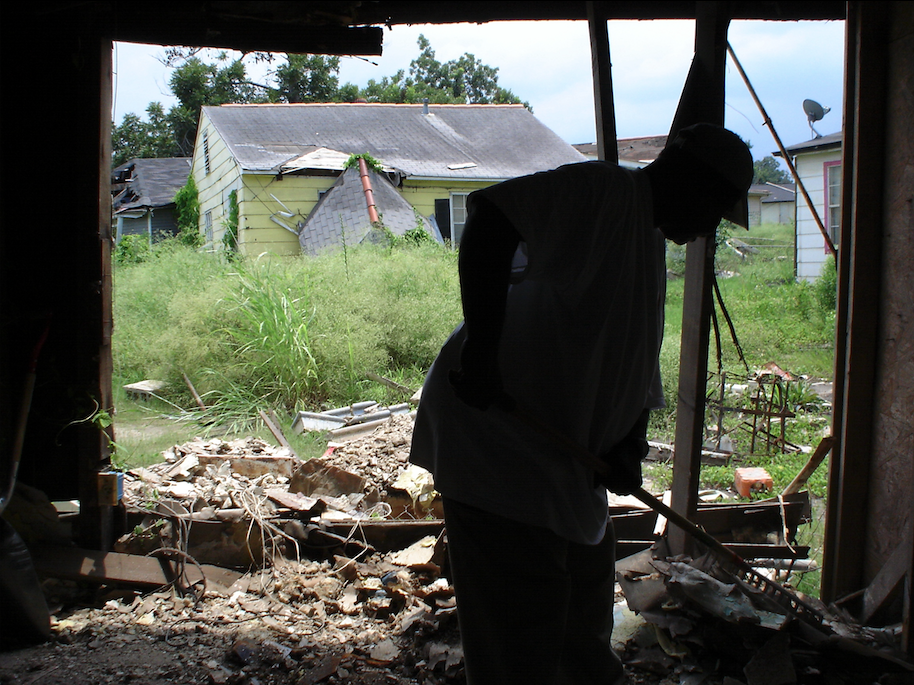
In August 2005, Hurricane Katrina wreaked havoc on New Orleans’ music heritage sites. While wind and rain took a toll, by far the worst losses followed the failures of the levee system, when 80% of the city flooded.
Demolitions and collapsed buildings
Some structures were wiped off the map relatively soon after the storm because their owners could not or would not rebuild.
For example, Ultrasonic Studios, where James Booker recorded Classified, was wrecked beyond repair. So were TwiRoPa Mills and the I.L.A. Hall, a longstanding venue for gospel programs and R&B shows, and many residences, like Al “Carnival Time” Johnson’s house in the Lower Ninth Ward.
The City of New Orleans elected to do away with its largest public housing complexes—the musically rich St. Bernard, Magnolia, Lafitte, and Calliope—regardless of the level of damage they sustained.
The City also tore down some public schools, including Booker T. Washington and Walter L. Cohen, which had developed chart-topping artists from Allen Toussaint to Mystikal, to replace them with new facilities. The Halfway House, an early jazz venue on publicly controlled land, was razed to make way for a new 911 call center.
Other demolitions came after private property owners, through lack of will, or, more often, lack of resources, left buildings vulnerable to City bulldozers.
Jazz legend Sidney Bechet’s former home, dilapidated before the flood, was demolished in a blight reduction push in 2010. Preservationists tried to raise funds to save Club Desire, a launching pad for Fats Domino, but it was taken down in 2016. Incubators of the city’s brass band revival, including Danny Barker’s house, Leroy Jones’ house, and the Fairview Baptist Church, were all leveled by 2024.
Katrina also weakened vulnerable structures that fell in subsequent storms. Wind damage from Katrina set Perseverance Hall, once a venue for Buddy Bolden and other jazz pioneers, on a path to structural failure in Hurricane Ida in 2021 and collapse in a thunderstorm in 2022. (Ida also laid waste to the Karnofsky building, a touchstone of Louis Armstrong’s upbringing, which had been neglected before, during, and after Katrina.)
The transformation and emptying of surviving buildings
Some structures damaged by Katrina and the levee failures were put to new uses after being repaired.
The building designed as Allen Toussaint’s Sea-Saint Studio eventually reopened as a hair salon. Dixie Taverne, a hub of the city’s metal and punk scenes for a decade before the storm, was renovated as an Irish pub. The former home of Rosemont Records, one of New Orleans’ first Black recording studios and most prolific labels, is now a preschool. Soul Queen Irma Thomas’ venue, The Lion’s Den, was inundated and remodeled as a nightclub called the Chocolate Bar (it’s now called Da Spot).
The City sold or repurposed some of its property as well. Andrew J. Bell Junior High, which produced a slew of brass band leaders, wound up in the hands of a nonprofit that converted the facility into artist housing.
A few music businesses managed to reopen for a time, but couldn’t sustain themselves in post-Katrina New Orleans. Donna’s Bar and Grill and the Green Room each presented brass bands for a few years, and the State Palace Theater, the heart of the region’s rave scene in the 1990s, hosted a few events, but all have spent more time as empty shells.
Similarly, Joseph S. Clark High School, alma mater of “Sweethearts of the Blues” Shirley and Lee as well as hip hop producer Mannie Fresh, reopened for some years before being phased out in 2019 and standing vacant. John McDonogh High School and its venerable band program also returned for a little while before its building was modernized and given to a charter elementary school.
Other structures have remained shuttered since 2005, including the former home of Brown Sugar Records, a beloved Uptown record store; WWOZ’s fabled treehouse studio in Armstrong Park; and, most conspicuously, the Municipal Auditorium, formerly the crown jewel of music venues in New Orleans, abutting Congo Square. Despite being gutted and repaired, Fats Domino’s house was never reoccupied either.
The City blocked comebacks for some venues. City Councilmember Jackie Clarkson refused to allow the Funky Butt to bring back live music to North Rampart Street in the months after Katrina, and officials denied permitting for a nightclub to resume operation where, in the early 1990s, the Big Easy seeded the rise of Big Boy and Cash Money Records.
Success stories
Peaches Records in Gentilly (also key to the rise of Cash Money) was a rare music business that flooded but managed to reestablish itself in a new location–it took over Tower Records’ storefront in the French Quarter before settling into an old Woolworth’s building Uptown.
Other success stories hinged on outside intervention. Antoinette K-Doe reopened the damaged Mother-in-Law Lounge with an outpouring of community support followed by volunteer labor and resources from a nonprofit called Hands On. The House of Dance and Feathers in the Lower Ninth Ward was destroyed, but rebuilt with help from, among others, architecture students from Kansas State University.
The largest-scale post-Katrina restoration was the Dew Drop Inn in 2024. The legendary Chitlin Circuit hub stopped presenting live music long before the levee failures, but residents were living in its old hotel rooms when it flooded in 2005. Today the Dew Drop is back as an inn and nightclub.
Read more about the effects of Hurricane Katrina on New Orleans’ music community.
Places in this Tour
- I.L.A. Hall
- Calliope (B.W. Cooper) Public Housing Development
- Booker T. Washington High School Auditorium
- Karnofsky Shop and Residence
- Dixie Taverne
- John McDonogh High School
- Bell Junior High School
- Rosemont Records
- Joseph S. Clark High School
- Municipal Auditorium
- WWOZ Treehouse Studio
- Perseverance Society Hall
- Danny and Blue Lu Barker's House
- Leroy Jones' Garage
- St. Bernard Public Housing Development
- The Big Easy
- Peaches Records
- Sea-Saint Studio
- Club Desire
- Fats Domino's House
- The House of Dance and Feathers
Videos
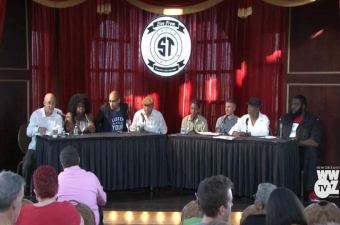
A panel discussion about the effects of Hurricane Katrina on New Orleans music and culture from 2015, the 10th anniversary of the flood.
Video by WWOZ.
A panel discussion about the effects of Hurricane Katrina on New Orleans music and culture from 2015, the 10th anniversary of the flood.
Images